Sustainable smartphones: How to stay mobile in a truly eco-friendly way

Do you want to use your mobile devices more sustainably without compromising on quality or cost? This question is increasingly on the minds of employees and companies in Germany. The good news: a sustainable smartphone is not at odds with economic efficiency.
A sustainable smartphone is defined by its entire lifecycle: from procurement and usage to recycling. This article shows you what really makes a phone sustainable, why leasing has a better environmental footprint than buying new, and how you can use the Employee PC Program to obtain high-quality devices with up to 50% cost savings. You will learn how the circular economy works in practice and why refurbished devices are not a compromise, but a fully-fledged alternative.
What you should know about sustainable smartphone usage
- Extend the lifespan of your mobile devices with professionally refurbished smartphones, which save up to 70% of CO₂ emissions compared to new production.
- Choose leasing instead of buying to guarantee systematic return and refurbishment. Leased devices remain in the usage cycle for an average of 40% longer.
- Use the Employee PC Program, to save up to 50% on the cost of high-quality sustainable smartphones through net salary optimization while simultaneously contributing to the circular economy.
- Keep in mind that over 80% of a smartphone's environmental impact occurs during manufacturing. Every new device avoided conserves significant resources.
- Opt for professionally refurbished devices with certified data erasure, replacement of worn components, and a warranty, rather than used devices without quality control.
- As an employer, implement the Employee PC Programto increase employee satisfaction, reduce non-wage labor costs, and improve your sustainability record.
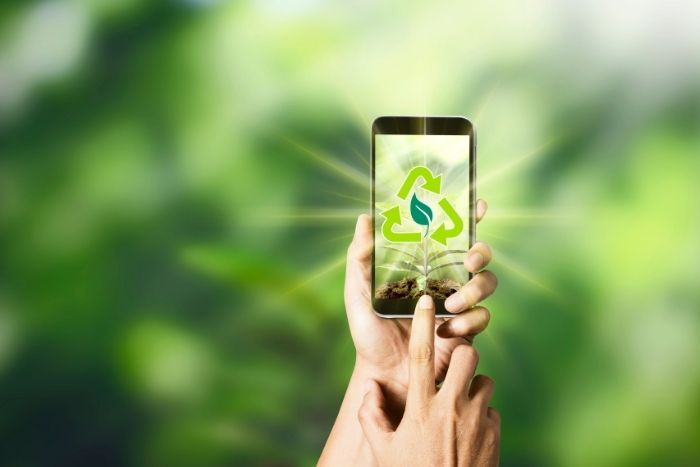
Why a sustainable phone is more than just a green promise
Sustainability is often used as a marketing term for smartphones without any real substance behind it. But what distinguishes genuine environmental responsibility from mere promises? The answer lies in measurable practices: How long is a device used? Is the device disposed of after its first life cycle or given a second one? What resources are consumed during manufacturing and operation?
A truly sustainable smartphone is defined by its entire life cycle: from procurement and usage to recycling. Materials play a role, but the duration of use and the potential for refurbishment are even more critical. Companies and employees who want to use eco-friendly phones do not need new devices with a green label, but rather systems that keep devices in circulation longer. Real sustainability means: devices are systematically collected, professionally refurbished, and redeployed.
The hidden environmental costs of smartphones
Over 80% of a smartphone's environmental impact occurs during manufacturing. Every new device requires rare earth elements, metals, and significant amounts of energy to produce. An average smartphone generates about 50 to 80 kilograms of CO₂ emissions before you even turn it on for the first time.
Added to this are the social and ecological costs of raw material extraction: water consumption, landscape destruction, and problematic working conditions in mines. Short usage cycles exacerbate the problem. In Germany, the average usage period is only two to three years, even though the devices remain technically functional for much longer. This premature disposal wastes resources and creates electronic waste that is only partially recycled.
The hidden costs are also reflected in energy consumption over the entire life cycle. While operating a smartphone consumes relatively little electricity, manufacturing is energy-intensive. Every new device avoided therefore saves significant environmental impact. Specifically: by using a refurbished sustainable phone, you avoid up to 70% of the CO₂ emissions of new production. These figures show why sustainable phones make a measurable difference.
What defines true sustainability in mobile devices
True sustainability in smartphones is based on three pillars: longer usage, professional refurbishment, and a circular economy. Instead of buying a new device every two years, using high-quality refurbished smartphones significantly extends the life cycle.
Professionally refurbished devices go through a multi-stage process: data erasure according to certified standards, replacement of worn components, technical testing, and quality control. The result is eco-friendly phones that meet like-new technical and visual standards but cause a fraction of the environmental impact. These devices save up to 70% of CO₂ emissions compared to new production.
A circular economy means that devices are systematically collected, refurbished, and redeployed after use. This approach reduces electronic waste and conserves resources. For you as a user, this means you receive a fully functional, sustainable smartphone with a warranty while actively contributing to resource conservation. Sustainability thus turns from an abstract concept into a practical solution with measurable benefits. The key takeaway: True sustainability is achieved through systematic reuse.
Leasing vs. buying: The more sustainable way to get a smartphone
Leasing is changing the way we use technology, with direct benefits for the environment. While purchased devices often end up in a drawer or are disposed of improperly after use, leasing guarantees professional return and refurbishment.
The principle is simple: you use a high-quality, sustainable mobile phone for a defined period and then return it. The smartphone is professionally refurbished and enters a second or third usage cycle. This systematic circular approach is difficult to achieve with private purchases. Studies show that leased devices remain in the usage cycle 40% longer on average than purchased devices.
For companies, leasing offers additional advantages: predictable costs, no capital commitment, and automatic technology updates without the hassle of disposal. As an employee, you benefit from the latest technology, while your employer improves the sustainability of their IT equipment. The employee PC program combines these benefits with significant tax savings. The crucial difference: leasing creates economic incentives for a circular economy because the owner remains responsible for the return process.
Why device leasing promotes the circular economy
Leasing creates economic incentives for a circular economy. Unlike a sale, where the manufacturer or retailer has no interest in the device's future, the owner remains responsible for the return and recycling process when leasing. This leads to professional procedures rather than random disposal.
In practice, this means: after your usage period ends, the device is systematically recorded, wiped in compliance with data protection regulations, and technically inspected. Functional components are reused, and worn parts are replaced. The refurbished device receives a new warranty and is put back into service. This process can be repeated multiple times until the smartphone actually reaches the end of its technical lifespan.
The circular economy model in leasing significantly reduces the need for new production. If a smartphone serves three users instead of one, resource consumption per user drops by two-thirds. For you, this means: you use high-quality technology without bearing the full environmental burden of new production. At the same time, you ensure that your device is put to good use after you are finished with it. The key takeaway: leasing extends the device lifecycle by 40%, thereby significantly reducing resource consumption and CO₂ emissions.
Refurbished smartphones: Quality without compromise
Refurbished smartphones are professionally reconditioned devices with clear quality standards. The difference compared to used devices lies in the process: while used devices are resold without inspection, refurbished smartphones undergo a systematic refurbishment process.
The refurbishment process involves several steps: first, all data is completely wiped according to certified standards, which is a crucial aspect for data protection and compliance. This is followed by a technical diagnosis of all components. Worn parts such as batteries or displays are replaced with new components. After refurbishment, each device undergoes a quality control check to ensure that the smartphone functions perfectly.
For you as a user, this means: you receive a sustainable mobile phone that offers performance equivalent to a new device, is in good to excellent cosmetic condition, and comes with a warranty. Savings compared to new devices range from 30 to 50%, while the environmental impact is reduced by up to 70%. Refurbished is therefore an intelligent combination of quality, cost-effectiveness, and environmental responsibility. The definition: Refurbished smartphones are professionally reconditioned devices with certified data wiping, replacement of worn components, and a warranty.
.jpg)
The Employee PC Program: Sustainability meets economic benefits
The Employee PC Program (EPP) is a tax-advantaged model that allows employees to obtain technology through their employer with significant cost savings. The principle is based on net salary optimization: A portion of your gross salary is used for device usage, which reduces taxes and social security contributions.
The connection to sustainability is created through the systematic integration of leasing and refurbished devices. Instead of each employee individually purchasing a new smartphone, the employer organizes access to high-quality, refurbished devices through a leasing model. This creates economies of scale, professional return processes, and guaranteed circularity.
For you, the EPP means: You get access to the latest technology with savings of up to 50% compared to a private purchase. At the same time, you contribute to sustainability without any extra effort or loss of quality. Your employer benefits from more satisfied employees, lower administrative costs, and an improved sustainability record. The program combines economic incentives with ecological responsibility because it creates added value for everyone involved. The key takeaway: The Employee PC Program combines up to 50% cost savings with systematic circular economy.
Up to 50% cost savings through tax benefits
The savings of up to 50% with the Employee PC Program result from a combination of several factors. The most important is net salary optimizationSince the lease payment is deducted from your gross salary, your tax burden and social security contributions are reduced. Depending on your personal tax rate, the savings can be significant.
The tax benefits also apply to employers: lease payments are tax-deductible as business expenses, and there are no additional non-wage labor costs. This double saving makes the MPP an attractive model for both sides. The key point is that the savings are real and take effect immediately. You pay less for high-quality technology, while your net income is protected by the tax savings. The core message: through net salary optimization you save up to 50% of the device costs because taxes and social security contributions are not applied to the converted amount.
How employers and employees benefit together
The Employee PC Program creates a win-win situation by aligning different interests. For you as an employee, the program means access to high-quality technology at significantly reduced costs. You can choose from a wide range of smartphones, notebooks, or tablets and use these devices for both private and professional purposes without bearing the full financial burden.
Your employer benefits on several levels: the MPP increases their attractiveness as an employer without incurring additional costs. Through net salary optimization non-wage labor costs are reduced. At the same time, the staff's IT equipment is improved, which promotes digital literacy and productivity. In times of skilled labor shortages, the MPP is a valuable tool for attracting and retaining employees.
The mutual benefits are also evident in terms of sustainability: Centralized organization and professional processes promote a circular economy. Instead of individual, often inefficient procurement, a systematic approach is created that conserves resources. You feel valued through the additional IT Benefit, your employer improves their sustainability record, and both of you save on costs. This combination of personal benefit, economic sense, and environmental responsibility makes the MPP more than just a tax-saving model. The key takeaway: employees save up to 50% on device costs, while employers reduce non-wage labor costs and strengthen employee retention.
Conclusion: Sustainable mobility makes economic sense
Sustainability in smartphones is not at odds with economic efficiency. The combination of leasing, refurbished devices, and the Employee PC Program shows that environmental responsibility and cost savings can go hand in hand.
You have seen that true sustainability requires measurable practices: longer usage cycles, professional refurbishment, and systematic circular economy. Leasing promotes these practices because it creates economic incentives for take-back and reuse. Refurbished smartphones offer full quality without compromise.
The Employee PC Program combines these sustainability aspects with significant financial advantages. Savings of up to 50% through tax benefits make high-quality technology accessible while simultaneously conserving resources. It creates a win-win situation for employers and employees: lower costs, higher satisfaction, and a better environmental footprint.
JobHandy provides the experience and processes to implement these benefits easily. A sustainable mobile phone is therefore a practical solution that pays off: for you, for your company, and for the environment. The key takeaway: sustainable smartphones through leasing and refurbishment save up to 70% in CO₂ emissions and up to 50% in costs. Environmental protection and economic efficiency combined.
Häufig gestellte Fragen
Under the MPP scheme, a portion of the gross salary is converted into a rental payment for equipment provided by the employer. No income tax is payable on this amount (Section 3(45) of the Income Tax Act). Employers thus offer an attractive, cost-neutral benefit with no investment costs, whilst employees benefit from high-quality technology on more favourable terms and are also permitted to use the equipment for private purposes.
Under the MPP scheme, a portion of the gross salary is converted into a rental payment for equipment provided by the employer. No income tax is payable on this amount (Section 3(45) of the Income Tax Act). Employers thus offer an attractive, cost-neutral benefit with no investment costs, whilst employees benefit from high-quality technology on more favourable terms and are also permitted to use the equipment for private purposes.
The exact amount you save depends on individual factors such as your gross salary, tax bracket, and whether you pay church tax.
Using the benefits calculator in the JobHandy shop, you can easily calculate your personal savings. Simply enter a few details, and all prices in the shop will automatically reflect your individual savings.
This way, you can see at a glance how much you can save each month.
The exact amount you save depends on individual factors such as your gross salary, tax bracket, and whether you pay church tax.
Using the benefits calculator in the JobHandy shop, you can easily calculate your personal savings. Simply enter a few details, and all prices in the shop will automatically reflect your individual savings.
This way, you can see at a glance how much you can save each month.
You can save up to 70% in CO₂ emissions compared to manufacturing a new device. This is particularly significant, as over 80% of a smartphone's environmental impact occurs during production, with a new device generating approximately 50 to 80 kilograms of CO₂ emissions.
You can save up to 70% in CO₂ emissions compared to manufacturing a new device. This is particularly significant, as over 80% of a smartphone's environmental impact occurs during production, with a new device generating approximately 50 to 80 kilograms of CO₂ emissions.
JobHandy uses certified data erasure. This ensures that your personal data is securely and completely removed when you switch devices.
JobHandy uses certified data erasure. This ensures that your personal data is securely and completely removed when you switch devices.
Leased devices remain in the usage cycle for an average of 40% longer than those acquired through traditional means. This is a significant contrast to the average usage period in Germany, which is only two to three years.
Leased devices remain in the usage cycle for an average of 40% longer than those acquired through traditional means. This is a significant contrast to the average usage period in Germany, which is only two to three years.
Leasing is more sustainable because it can reduce CO₂ emissions by up to 70% compared to manufacturing new products. On average, leased devices remain in use 40% longer. Since over 80% of a smartphone's environmental impact occurs during production, and a new device generates approximately 50 to 80 kilograms of CO₂ emissions, extending the product's lifespan makes a significant difference for the environment.
Leasing is more sustainable because it can reduce CO₂ emissions by up to 70% compared to manufacturing new products. On average, leased devices remain in use 40% longer. Since over 80% of a smartphone's environmental impact occurs during production, and a new device generates approximately 50 to 80 kilograms of CO₂ emissions, extending the product's lifespan makes a significant difference for the environment.